2024
Lingua
UX/UI Design
Speculative Design
Exhibited at Believe It or Not, DotDotDot, Milan (2025).
Exhibited at Stories Make Worlds, Festival della Meraviglia, Laveno Mombello (2026).
Overview
Lingua is a critical, speculative design project exploring how restricting language constrains thought and cultural identity. It materializes an authoritarian scenario where total control is disguised as peace, brought to life through a working learning console, a pictogram system, and physical propaganda artifacts.
My contribution
Speculative narrative & system mechanics
Visual identity & pictogram design system
Editorial design & publication artifacts
Project’s scope
Speculative worldbuilding & narrative videos, linguistic system, functional console, regime design system, editorial propaganda artifacts.
Timeframe
3 months, October 2024 - January 2025
01
Speculative Narrative
The project explores language as a tool of thought and resistance, speculating on a regime that imposes a simplified tongue to erase cultural identity and restrict cognitive freedom through tangible artifacts.
02
Institutional Identity
The regime's identity draws on authoritarian rhetoric. It employs a calm, sterile aesthetic and a strictly greyscale palette, masking pervasive control beneath an illusion of institutional order.


03
Linguistic Genesis
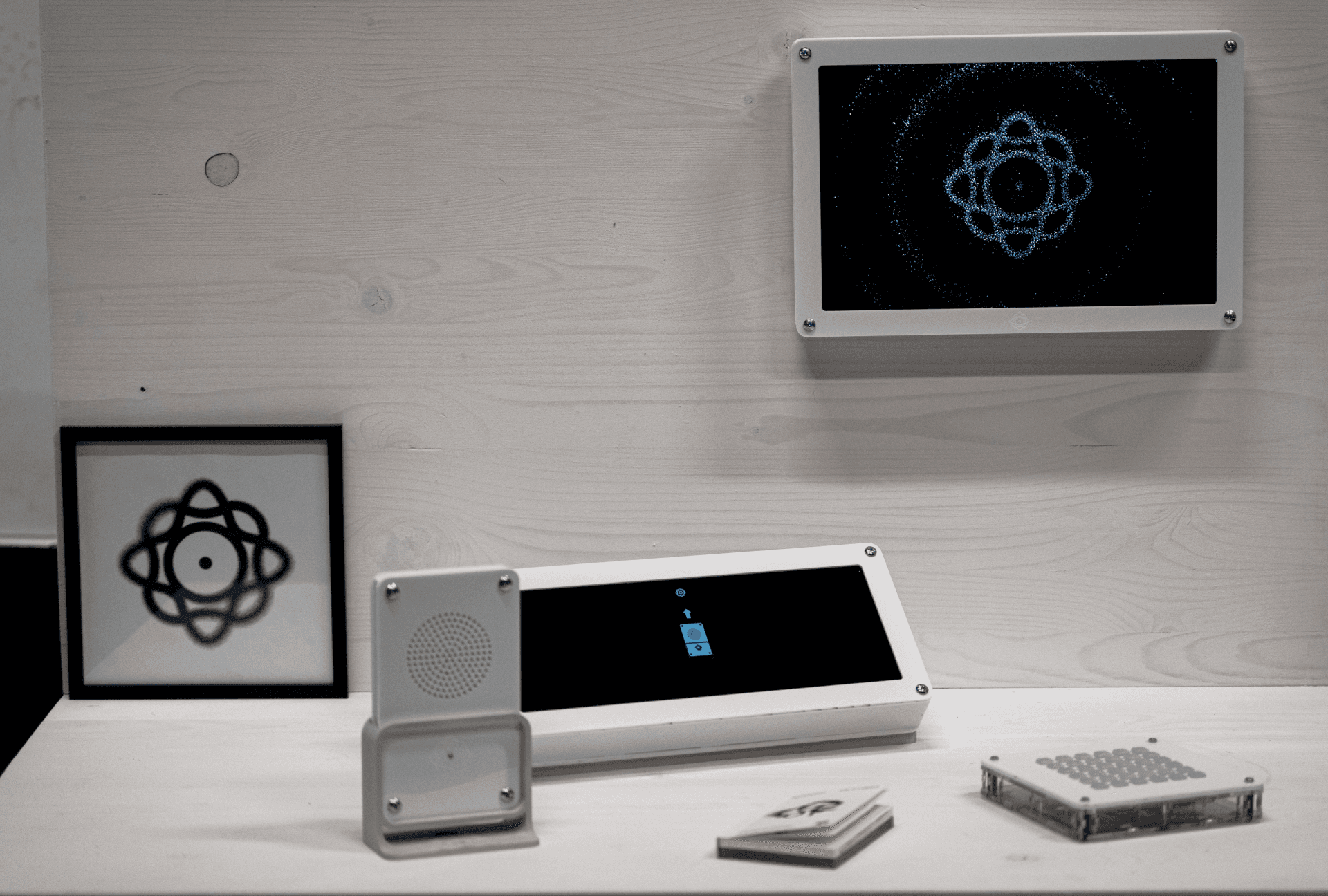
Grounded in cymatics, the language translates acoustic frequencies into geometric glyphs, fixing sound into a vocabulary of 55 concepts. From these geometries emerges a minimalist syntax, abandoning the spoken voice in favor of a silent gestural code.


04
Learning Device
Positioned inside the home, the console weaves ideological control into daily ritual. The system strips oppositional concepts from the lexicon, neutralizing dissent into enforced optimism. By controlling the boundaries of language, it dictates what can be thought: what cannot be spoken ceases to exist.


05
Exhibition History
The project and its functional prototype were featured across speculative and interactive design showcases.


Key Learnings
Critical & speculative design thinking
Multi-artifact worldbuilding
Prototyping tangible interfaces
Additional credits
Project developed with Diana Berselli, Stella Facconi, Filippo Mirandola, Chiara Monti and Matteo Roscigno for Politecnico di Milano.